

Ask an assistant to describe a mid-sized accounting firm, a neighbourhood clinic, or a person with a modest public profile, and you will usually get a confident, fluent paragraph. Some of it will be right. Some of it will be three years out of date. Occasionally a detail will belong to a different entity with a similar name.
The answer arrives without a citation trail, without a confidence level, and without any indication of which parts were verified. And unlike a search results page, it does not present itself as a list of sources to evaluate. It presents itself as an answer.
That shift deserves more attention than it gets. We spent two decades teaching people to assess the credibility of the pages they landed on. The current generation of tools removes the landing entirely, and with it the moment where a reader decides whether to trust a source.
Where AI Answers About People and Businesses Come From
The inputs are less mysterious than they appear. Assistants draw on what was in their training data, and increasingly on what they can retrieve at the moment you ask: web pages, business listings, directories, news archives, review platforms, social profiles, and aggregators that quietly republish all of the above.
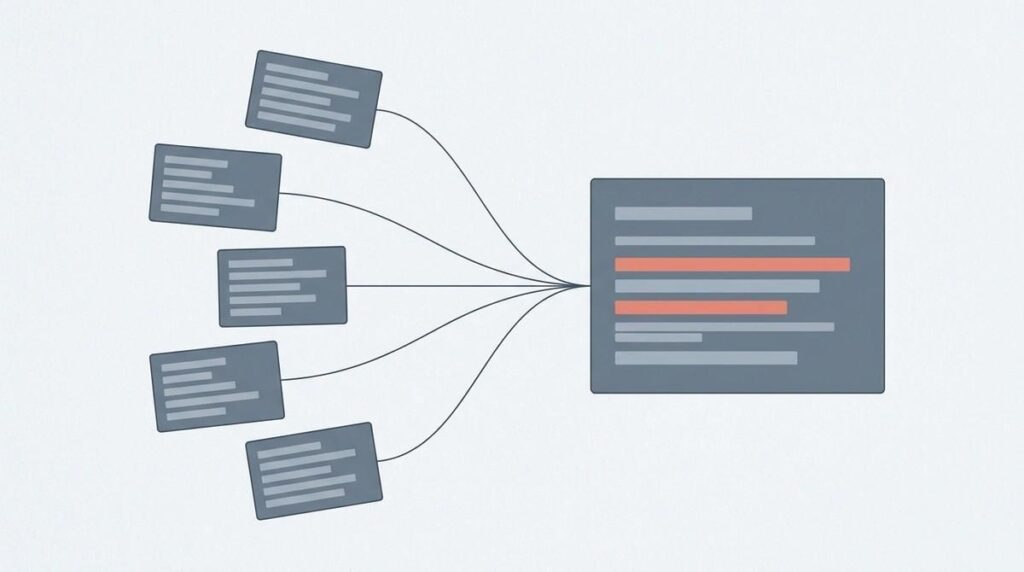
Most organizations assume the fix is volume, that being written about more often produces a more accurate description. Mehrana Marketing, which audits how companies appear in AI-generated answers, argues the opposite: what decides accuracy is consistency, not coverage. An entity whose name, address, leadership and service description match across every machine-readable source gets summarized correctly. One with four slightly different versions in circulation gets a blended answer, and blended answers are where the errors live.
The Missing Verification Layer in AI Search
Traditional search had a crude but functional accountability structure. If a page said something false about you, the page had a publisher, a domain, and usually a contact address. You could ask for a correction, and if the publisher refused, there were escalation routes: platform policies, defamation law, regulators.
A generated summary has no publisher in that sense. The claim did not originate anywhere in particular. It was assembled. There is no page to correct, no author to contact, and no version history showing what the system said about you last month.
This is not a hypothetical gap. It is the ordinary operating condition of a technology that now sits in front of search, email, phones, and customer service, and it has no equivalent of the correction mechanism that every previous information system eventually acquired.
Structured Data Decides Who Gets Described Accurately
The practical consequence is an accuracy gap that tracks resources rather than truth.
Why Large Organizations Come Out Ahead
A large company publishes structured data about itself deliberately. It maintains schema markup on its website, keeps its entries on major platforms current, issues press releases that get indexed, and has enough coverage in reputable outlets that the consistent version of its story dominates. When an assistant describes it, the description is accurate because the organization did the work to make the accurate version the easiest one to find.
What Happens to Everyone Else
A sole practitioner, a small nonprofit, a clinic with one location, or a private individual has none of that machinery. Their information exists in fragments, often entered years ago by someone else: an old directory listing, a defunct association page, a scraped profile they never created. The assistant does its best with the fragments, and the result is a description assembled from the most available data rather than the most accurate.
Nobody designed this as a tiered system. It is simply what happens when fluency outpaces verification.
Correction Without a Correction Mechanism
Other information systems solved this, slowly and incompletely, by creating a right to be corrected.
Credit reporting is the clearest precedent. Credit bureaus assemble profiles from third-party data, make consequential claims about people, and are legally obliged to investigate disputes and fix errors. Data protection law went further in places: the right to rectification under European data protection rules gives individuals a route to demand inaccurate personal data be corrected, and Canadian privacy law contains an accuracy principle of its own.
None of these frameworks map cleanly onto generated answers. The output is not stored as a record. It is produced fresh each time, slightly differently, which makes it genuinely hard to say what has been corrected when a provider says it has fixed something. The honest position is that the law has not caught up, and the technical architecture makes catching up harder than it was for a database of records.

Data Ownership Questions AI Search Has Not Answered
A few questions follow from this.
If a system makes a claim about an entity drawn from a source that entity never authorized, who is accountable for it? If a description is accurate about the past but misleading about the present, does the entity have any standing to insist it be refreshed? If accuracy depends on having published structured data about yourself, has publishing become a precondition for being described fairly? And if so, what happens to the people and organizations who never will?
These are data ownership questions in a new form. The older version asked who holds your data. This one asks who holds the summary of it, and whether anyone owes you a correction.
What Individuals and Small Organizations Can Actually Do
Waiting for a correction mechanism is not a plan. In the meantime the practical advice is narrow but real.
Check what is said about you, in more than one assistant, and write down the specific errors rather than the general impression. Find the sources those errors most likely came from: an outdated listing, an old bio on a former employer’s site, a directory entry with a dead phone number. Correct them at the source, because the source is the only thing you can actually edit. Make the accurate version easy to find and consistent everywhere you control, including your own site.
This is a workaround, not a remedy. It asks the affected party to do the verification work the system skipped, which is exactly the wrong allocation of effort, and it only works at all for those with the time to do it.
Why Accuracy Is an Ethics Problem, Not a Marketing One
It is tempting to file all of this under reputation management and move on. That framing is a mistake, because it treats an accuracy failure as a competitive disadvantage rather than a harm.
When a system confidently describes a clinic’s hours, a lawyer’s specialty, or a charity’s mandate incorrectly, somebody acts on it. The cost lands on whoever was described, and the party best positioned to prevent it is the one that generated the claim. Until verification and correction are built in rather than left to the described, the gap between fluency and truth is not a technical limitation. It is a decision about who carries the risk.