
TL;DR: The robot development cycle gets shorter when teams reduce custom work in early stages, test in realistic conditions sooner, and keep software, hardware, and operations aligned around repeatable milestones. In practice, that means using a stable prototyping robot platform, running field testing sessions before the design is “finished,” and treating the R&D robotics workflow as a sequence of measurable integration steps rather than a linear build process.
How does the robot development cycle actually get shorter?
The robot development cycle is often delayed by avoidable integration work. A mobile robot may have a solid navigation stack, a capable perception model, and reliable low-level control, yet still spend weeks blocked by power distribution changes, enclosure redesigns, driver mismatches, or outdoor testing logistics. What slows teams down is usually not one major failure, but many small dependencies arriving late.
In mobile robotics, shortening the robot development cycle usually depends on moving uncertainty forward. Instead of waiting for a custom chassis, custom compute carrier, and custom I/O design to be ready at the same time, R&D teams can validate autonomy, teleoperation, payload mounting, and data collection on a working base first. This is where a prototyping robot platform changes the pace of work. It separates the question “does the robotic function work?” from “is the final mechanical package complete?”
That distinction matters in time-to-field robotics. A robot that reaches dirt, grass, slopes, dust, rain exposure, and intermittent network conditions early will reveal issues that are invisible in the lab. Those findings are usually more valuable than another week of bench refinement.
What usually breaks the R&D robotics workflow?
A healthy R&D robotics workflow is not just a Gantt chart. It is a practical agreement about what must be proven, in what order, and on which platform. Teams lose time when milestones are defined around component delivery rather than system behavior.
Several recurring failure modes tend to stretch the robot development cycle:
- Software teams build against simulated interfaces that do not match the real robot.
- Mechanical teams optimize packaging before payload requirements are stable.
- Electrical changes appear late and force retesting of drivers, thermals, or power budgets.
- Field validation is postponed until after “final integration,” which makes every issue more expensive to isolate.
- Test procedures are informal, so failures found during field testing sessions cannot be reproduced consistently.
What a strong R&D robotics workflow does differently is make testability part of the architecture. ROS 2 nodes, sensor interfaces, compute layout, and payload mounts are selected not only for performance but also for repeatable integration. That approach helps teams swap sensors, compare algorithms, and log failures without rebuilding the whole stack each time.
When is a prototyping robot platform better than starting from a custom design?
A prototyping robot platform is useful when the project still contains open technical questions. Examples include localization method selection, autonomy level, communications architecture, payload mass distribution, or expected terrain envelope. In these cases, the fastest route is often not a custom platform but a stable baseline that can go outside quickly and accept new hardware without major rework.
This is one reason teams use ready mobile platforms for time-to-field robotics. If the immediate goal is to verify mapping on rough terrain, compare camera and LiDAR placement, or collect datasets under real weather and lighting conditions, an existing rover can remove weeks or months of non-differentiating engineering work.
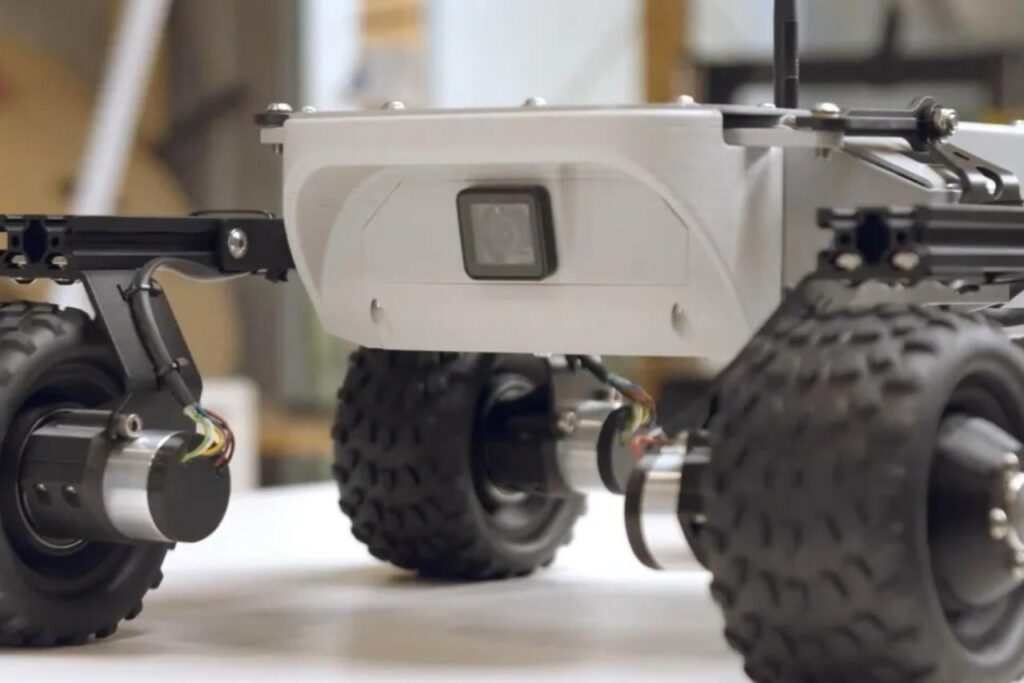
As a practical example, Fictionlab builds open-source mobile platforms such as the Leo Rover and Raph Rover that can serve as a ready base for field testing. In the context of the robot development cycle, that kind of platform helps teams test payloads, autonomy software, and operational assumptions earlier, before committing to final mechanical architecture.
How should field testing work be structured to reveal real issues early?
Field testing work is most effective when it is treated as an engineering experiment, not a demo. The purpose is to expose coupling between terrain, sensing, control, power, communications, and operator procedures. If the test only shows that the robot can move, it has not said much.
To shorten the robot development cycle, field tests should answer specific questions. A useful sequence often looks like this:
- Start with baseline mobility and power tests on known terrain.
- Add one variable at a time, such as a new sensor, mast height, compute load, or autonomy mode.
- Log ROS 2 topics, network quality, CPU load, battery behavior, and operator actions.
- Repeat the same route or task so results remain comparable.
- Convert every field failure into a bench test or simulation case where possible.
This is how field testing practice feeds the R&D robotics workflow. A muddy incline may reveal wheel slip that affects odometry. A long wireless link may expose delayed teleoperation feedback. A hot enclosure may throttle compute during inference. These are not edge cases if the robot is expected to operate outside a lab.
Why does time-to-field robotics matter more than time-to-demo?
Time-to-field robotics is about reaching the conditions that define actual system behavior. A polished indoor demo can hide weak connectors, unstable payload mounts, poor ingress protection, or localization drift caused by vegetation and changing light. A shorter robot development cycle comes from meeting those conditions earlier, when architecture is still flexible.
What time-to-field robotics changes is decision quality. Teams can decide from evidence whether the robot needs different suspension, sensor placement, compute cooling, or operator tooling. Without those tests, discussions stay theoretical and redesigns arrive late.
In practice, the best teams do not wait for the robot to feel finished. They aim for “safe enough, instrumented enough, repeatable enough” and then iterate. That mindset is often what separates a disciplined robotics company from one that keeps rebuilding prototypes without learning fast enough.
What habits make the robot development cycle more predictable?
A predictable robot development cycle depends on engineering habits more than slogans. The goal is not speed at any cost. The goal is to make each iteration produce information that reduces uncertainty.
Several habits consistently improve the R&D robotics workflow:
- Define milestones as verified behaviors, not delivered parts.
- Use a stable prototyping robot platform until the custom design is justified by test evidence.
- Schedule recurring field testing sessions instead of one large final validation phase.
- Keep software deployment, logging, and rollback simple enough for use outdoors.
- Record what changed between tests so failures can be traced to one variable.
For teams working in ROS 2, this usually means clear interface contracts, hardware abstraction where it helps, and disciplined bagging of data from every meaningful run. None of that is glamorous. It is simply how time-to-field robotics becomes faster without making the process fragile.
If the objective is to shorten the robot development cycle, the practical lesson is straightforward: put the robot in realistic conditions earlier, reduce unnecessary custom work in the first iterations, and let the R&D robotics workflow revolve around repeatable evidence. That is where development speed starts to become real.