For indie makers and prompt-first creators, the current generative media landscape feels less like a library and more like an arms race. Every week, a new interface appears, promising “unmatched realism” or “revolutionary workflows.” Most evaluations of these tools fall into the trap of the feature checklist: Does it have an upscaler? Can it do text-to-image? Is there a gallery?
This surface-level comparison is increasingly useless. As the underlying models—from Stable Diffusion variants to proprietary engines—become more accessible, the differentiator is no longer the presence of a feature, but the logic of its implementation. An operator doesn’t just need an AI Image Editor; they need to know how that editor handles semantic weight, how much friction it introduces into a rapid iteration cycle, and how it manages the transition from a raw generation to a production-ready asset.
To choose a tool that actually survives a month of daily use, we have to move beyond the UI and look at the engine’s behavior under pressure.
The Deception of the ‘Feature-Rich’ Interface
Standard SaaS evaluation frameworks often fail when applied to generative AI. In traditional software, a “remove background” button is a binary—it either works or it doesn’t. In the generative world, that same button might rely on an outdated segmentation model that leaves jagged artifacts, or a modern transformer-based approach that understands hair and transparency.
Indie makers often waste significant time on interfaces that look professional but hide poor model performance. A cluttered sidebar filled with “pro” sliders can often be a mask for a model that lacks basic prompt adherence. If you have to spend twenty minutes tweaking “lighting” and “contrast” sliders to fix a fundamentally broken generation, the tool has failed its primary job.
The operator’s perspective prioritizes the cohesive generative architecture. You want to see how the platform handles the relationship between the prompt and the output. Does it allow for direct model switching, or does it force every request through a single, over-optimized “generalist” model that flattens your specific creative intent? A truly capable AI Image Editor isn’t just a collection of buttons; it is a gateway to a model that respects the nuances of the user’s input.
Benchmarking Semantic Adherence Over Pixel Density
Resolution is the most overused and least helpful metric in AI media. Any tool can run an output through a generic upscaler to produce a 4K image. The real test is semantic adherence: the model’s ability to translate complex, multi-subject prompts into a coherent visual layout without losing the “logic” of the scene.
When testing a tool, move away from simple prompts like “a cat on a chair.” Instead, use “stress-test” prompts that involve spatial relationships, such as “a small blue cube sitting on top of a large red sphere, with a yellow pyramid to the left.” Many high-profile models struggle with these basic prepositional relationships. If the tool can’t handle the physics of a prompt, it will fail you when you’re trying to generate complex marketing assets or character-consistent storyboards.
Another critical factor is stylistic drift. When you generate five variations of a concept, does the tool maintain a consistent aesthetic, or does it bounce between hyper-realism and digital painting? Professional-grade tools allow you to pin certain parameters—often through seed control or specific style references—to ensure that your tenth generation looks like it belongs in the same universe as your first.
Workflow Friction and the Speed of Iteration
In a prompt-first workflow, the first generation is rarely the final one. You might go through 50 iterations, refining the prompt or adjusting the “guidance scale” to find the right balance between creativity and adherence. This is where high-latency models become a liability. If every generation takes 60 seconds, a 50-iteration session eats up nearly an hour of active production time.
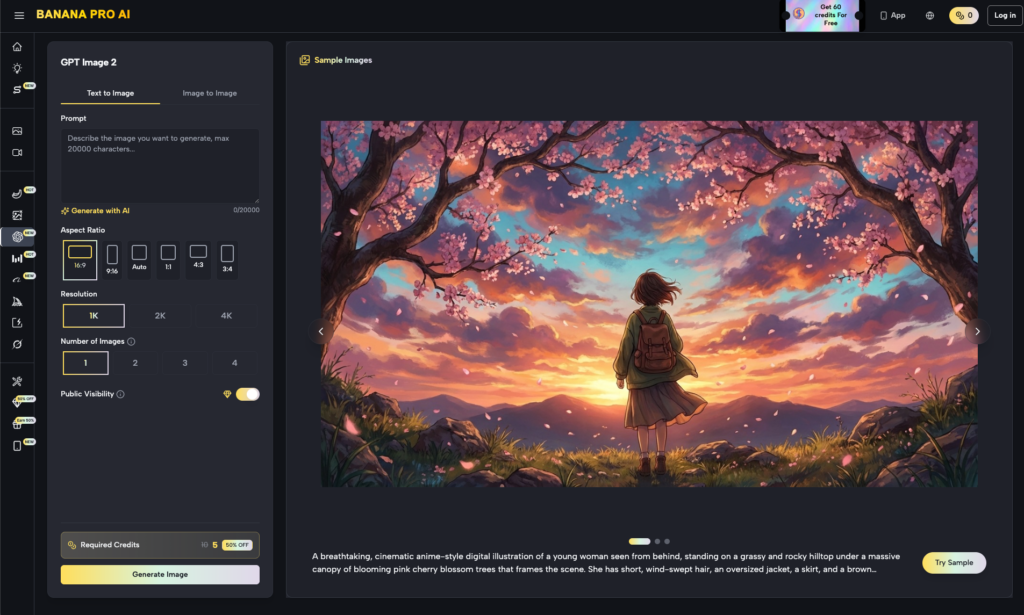
This is the specific utility of Nano Banana, which functions as a high-speed engine for rapid prototyping. Instead of committing heavy compute and long wait times to an unrefined idea, an operator can use a faster, leaner model to “sketch” in real-time. Once the composition and color palette are locked in, they can move the concept to a higher-fidelity model within the same ecosystem.
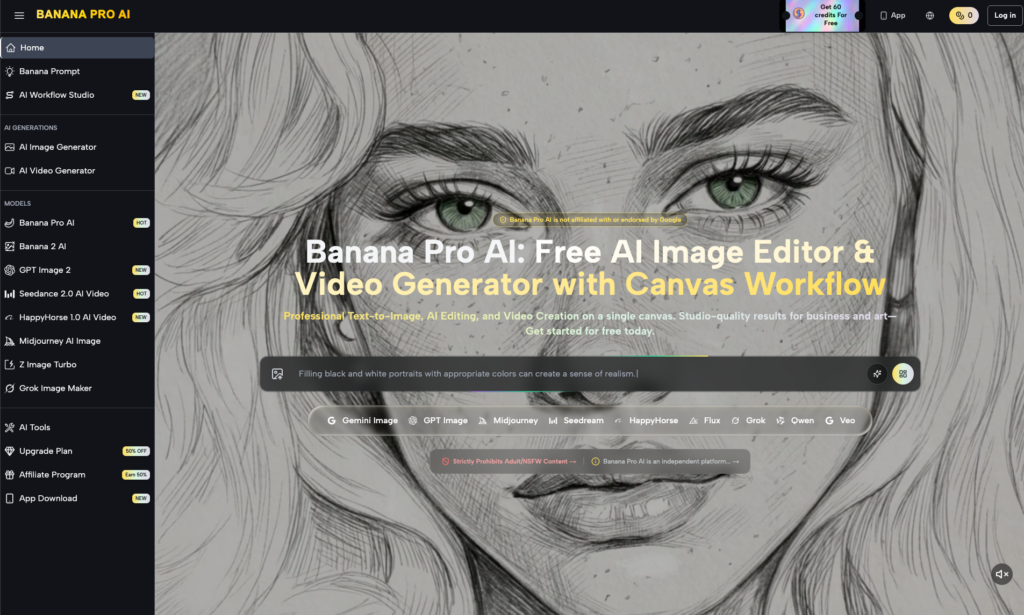
Reducing context switching is the “secret sauce” of a productive stack. If you have to download an image from one site, upload it to another for upscaling, and then move it to a third for a specific AI Photo Editor task like in-painting, you aren’t just losing time—you’re losing the iterative flow. Platforms like Banana AI solve this by keeping the generative and editing layers in one place, allowing the output of one model to immediately serve as the input for another.
Evaluating the Post-Generation Layer
The industry is currently shifting from “generation” to “modification.” For an indie maker, a tool that can generate a beautiful sunset is common; a tool that can take that sunset and accurately change the position of the sun while recalculating the shadows on the ground is rare.
When evaluating an AI Photo Editor, the criteria must focus on context-awareness. Traditional retouching tools work on a pixel-manipulation level—cloning, healing, and blurring. Generative editing works on a conceptual level. If you are using an in-painting tool to add a pair of sunglasses to a person, the editor needs to understand the lighting of the original scene and apply the correct reflections to the lenses.
“One-click” solutions are often a red flag for serious creators. While they look impressive in marketing demos, they usually offer very little control over the final result. A functional AI Image Editor should provide a balance: automated heavy lifting for the initial masking, but granular control over the “denoising strength” and prompt influence during the actual edit. If you can’t tell the tool exactly how much of the original image to keep, you are at the mercy of the model’s randomness.
Limits of Generative Evaluation and Future Uncertainties
It is important to acknowledge that no evaluation framework is permanent. We are currently in a period of high volatility regarding model performance. One of the most frustrating aspects for professional creators is “model burnout” or unexpected shifts in output quality after a platform updates its underlying API. A prompt that worked perfectly yesterday might produce subpar results today because the provider changed the weights of their safety filters or optimized the model for speed over detail.
Furthermore, benchmarks for “artistic quality” are inherently subjective. What one creator sees as “cinematic lighting,” another might see as “over-saturated and plastic.” There is no objective metric for beauty, and relying solely on curated “top-tier” galleries in a tool’s marketing materials is a mistake. These galleries are the result of thousands of failed generations that you never see.
There is also a lingering uncertainty regarding the long-term provenance and copyright standards for different proprietary models. While many platforms offer “commercial use” licenses, the legal landscape is still catching up to the technology. Operators should be cautious about building entire businesses on models that lack transparency regarding their training data, as future regulations could impact the viability of those assets.
Constructing a Personalized Generative Stack
Building a workflow isn’t about finding the “best” tool, but about matching specific project needs to model strengths. An indie maker might use a Gemini-based model for projects requiring high-fidelity realism, while switching to a Seedance-based engine when they need to explore motion and video.
The goal is to avoid tool bloat. You don’t need five different subscriptions; you need one or two platforms that offer a variety of specialized models. Look for tools that prioritize operator agency. The best interfaces are the ones that get out of the way and allow you to interact directly with the model’s logic.
Ultimately, the value of a generative tool is measured by the distance between the idea in your head and the pixels on the screen. If a tool requires you to fight against its interface or “guess” why a prompt failed, it’s not a professional tool—it’s a toy. By focusing on semantic adherence, iteration speed, and contextual editing, you can build a stack that actually supports the creative process rather than just providing a temporary novelty.