
An AI image can be generated in minutes, but the difficult questions often begin after the image appears. Should you upload this reference photo? Is the result appropriate to publish? Does the audience need to know how it was made? A tool such as Nano Banana can make visual experimentation accessible, yet convenience does not remove the creator’s responsibility. Responsible use is less about memorizing one universal rule and more about making a few careful decisions before, during, and after generation. A practical routine can prevent many avoidable problems.
Begin With the Material You Are Putting Into the Tool
The first ethical decision happens before the prompt. If you are uploading an image, ask whether you have a legitimate reason to use it.
A photo you took yourself is different from a stranger’s portrait downloaded from social media. A sketch you created for a project is different from a client file covered by a confidentiality agreement. The same applies to screenshots, logos, school materials, workplace documents, and images of children.
When the source includes another person, permission matters. When it includes private or confidential information, stop and consider whether an AI service should receive it at all. Responsible creation begins with controlling the input, not merely reviewing the output.
Three Questions to Ask Before You Generate
A short pre-generation check is easier to follow than a long policy document. These three questions cover many everyday situations.
1. Do I Have a Good Reason to Use This Source?
Ask where the reference came from and what rights or permission you have. If the answer is unclear, choose another source.
For a mood-board exercise, you can often avoid personal photos entirely and work from your own prompt. For a portrait edit, use your own image or one supplied with clear permission. For client work, follow the client’s rules rather than assuming that an image is safe to upload because it was sent to you.
2. Could the Result Mislead Someone?
The risk depends on context. A fantasy landscape is unlikely to be mistaken for documentary evidence. A realistic image of a person, business, event, or product can be interpreted very differently.
Before publishing, ask what a reasonable viewer may believe. If an AI-generated scene could be taken as a photograph of a real event, consider labeling it or placing it in a context that makes its nature clear. The more realistic and consequential the subject, the more important that judgment becomes.
3. Who Could Be Affected by the Image?
Creators naturally focus on whether an image looks good. Ethical review asks a second question: who is represented, referenced, or potentially harmed?
A joke image involving a friend may feel harmless to the person making it but uncomfortable to the person depicted. An edited product photo may create expectations that the real item cannot meet. A synthetic portrait may unintentionally resemble someone. Thinking about the people downstream of the generation helps catch problems that visual quality checks miss.
Separate Creative Experimentation From Public Claims
Private experimentation gives you more room than public communication. You might generate several exaggerated visual directions while brainstorming a poster, a game scene, or a fictional character. That does not mean every experiment should be published as-is.
The distinction becomes important when the image supports a factual claim. If you are illustrating a real location, historical event, news story, product, or person, viewers may read visual details as evidence. In those cases, label synthetic imagery when needed and avoid presenting invented details as observed facts.
This habit does not make creative work less interesting. It simply keeps fiction, visualization, and documentation from being mixed together in ways the audience cannot reasonably detect.
For example, imagine a community group creating a poster for a real cleanup event. A generated background can be decorative, but adding invented crowds, sponsor logos, or facilities may imply things that are not actually part of the event. Keeping the creative layer separate from factual event information makes the poster safer and easier to trust.
Use Editing Tools With a Clear Change List
Image-to-image tools are most useful when you know exactly what you intend to change. Nano Banana AI can be used for image-based generation and visual editing, making it relevant to tasks such as exploring a new background or visual direction from an existing source.
Before editing, write a tiny change list: “replace the background, keep the person recognizable, remove the sign.” After generation, compare the result with that list. AI systems can alter details you did not request, so inspect faces, text, objects, uniforms, symbols, and product features rather than assuming unchanged areas stayed accurate.
Precision in the request should be followed by precision in the review.
A Simple Publication Check Is Better Than Blind Trust
Before using an AI image publicly, perform one last review from the audience’s perspective.
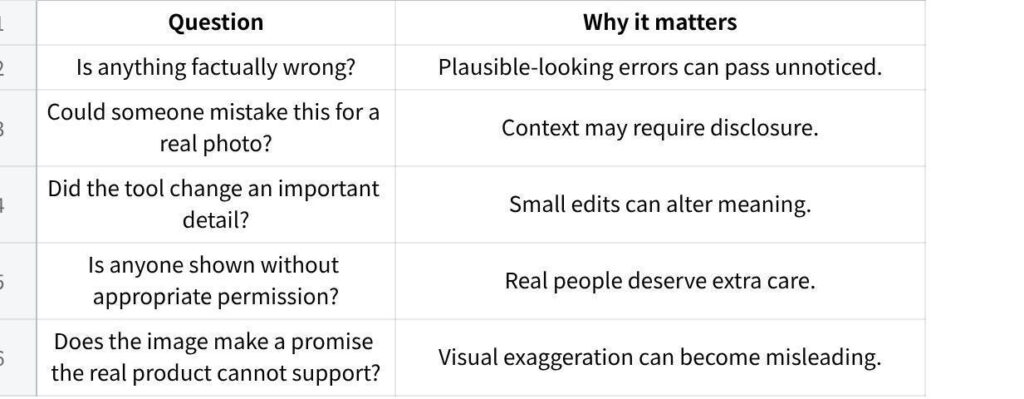
点击图片可查看完整电子表格
This check is especially useful for teams. One person may be impressed by the composition while another notices incorrect text or an unintended implication.
Do not outsource the final decision to the model. A generator can produce options, but it does not know the full social context in which you will use them. It may not understand an inside joke, a local cultural reference, a sensitive news event, a classroom rule, or a client relationship.
That means the human role becomes more important, not less. You decide what source material is appropriate, what prompt is fair, what output is accurate enough, and what requires disclosure or revision. If a result feels questionable, generating a cleaner version is usually easier than defending a careless one later.
The useful habit is simple: use AI for possibilities, then apply human standards before the image leaves your screen.
Create a Small Record for Important Work
For casual experiments, you do not need an elaborate archive. For client, editorial, educational, or public-facing work, basic documentation can be helpful.
Save the original source, the prompt or instruction, and the selected output. Add a short note if substantial changes were made after generation. This creates a simple trail showing how the final image developed. It also helps when a teammate later asks why a particular visual choice was made.
Documentation is not a guarantee that every decision was correct. It is a practical way to make the process easier to review, reproduce, and discuss. Responsible use becomes much easier when the work is not a black box.
Conclusion
Ethical AI image use is mostly a series of ordinary decisions made with attention. Check the source before uploading, think about who could be affected, distinguish experimentation from factual communication, and inspect the result before publishing it. No generator can make those judgments for you. The most useful next step is to create a short personal checklist that fits the work you actually do, then apply it consistently. Try it on your next image task before you write the first prompt, not after the final image is already public.